The heat you are dumping is worth more than you think.
If you sit within 2 km of a district heating network, your data center becomes a thermal energy supplier. Cooling stops being a cost and becomes a revenue line.
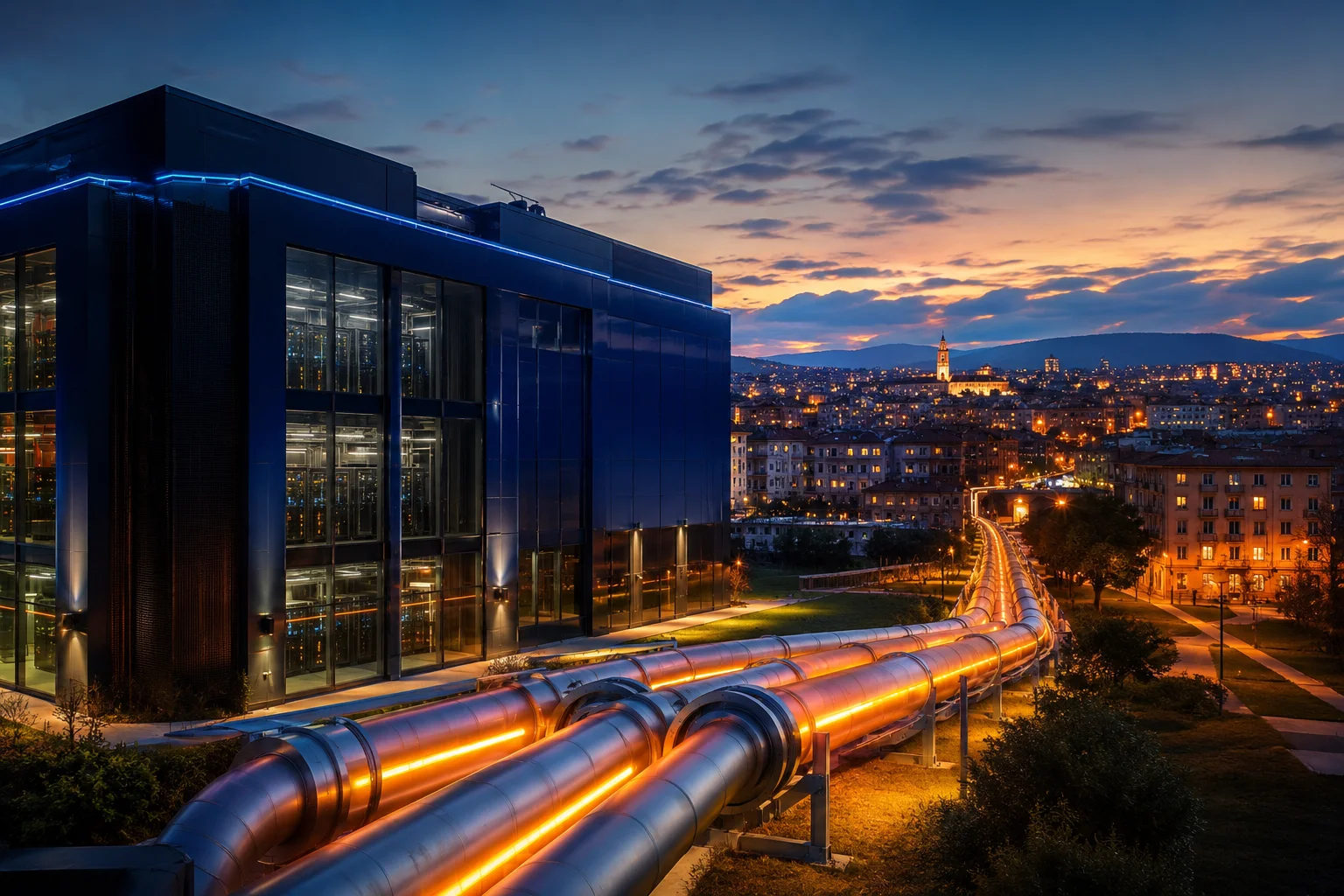
Reference: 10 MW IT data center, 150 kW per rack.
Cooling is a cost centre. Heat is an opportunity.
Today you buy electricity to produce cold, then dump the heat into the atmosphere. With AI densities of 150 kW per rack, this cost grows non-linearly.
In a blackout, cooling is unprotected: no UPS shields the data center's most critical asset. Waste heat, on the other hand, has a market: the nearby DHC network is willing to buy it at a tariff.
You are leaving a direct revenue line on the table and keeping an operational risk that can be eliminated.
Four economic levers in a single plant.
RHP lifts the cooling fluid to 80-90°C and delivers it continuously to the DHC network. You negotiate the tariff directly with the network operator: your heat is decarbonised (zero combustion, zero direct emissions), exactly the thermal source that European directives RED III and EED require DHC networks to integrate. You have the right product at the right time. In parallel, Thermal UPS: continuous cooling even in a blackout, for as long as the electrical UPS lasts. The platform is DC-native, compatible with the 800V bus of high-density AI racks.
Direct revenue from decarbonised heat
Heat delivered to the DHC network at a contracted tariff. Zero combustion, zero direct emissions: the thermal source RED III and EED prioritise.
Electricity savings
PUE from 1.12 to 1.01, with auxiliaries self-powered via ORC.
Avoided CAPEX
No traditional cooling batteries: Thermal UPS already built in.
Reduced conversion losses
DC-native architecture, native integration with the 800V bus.
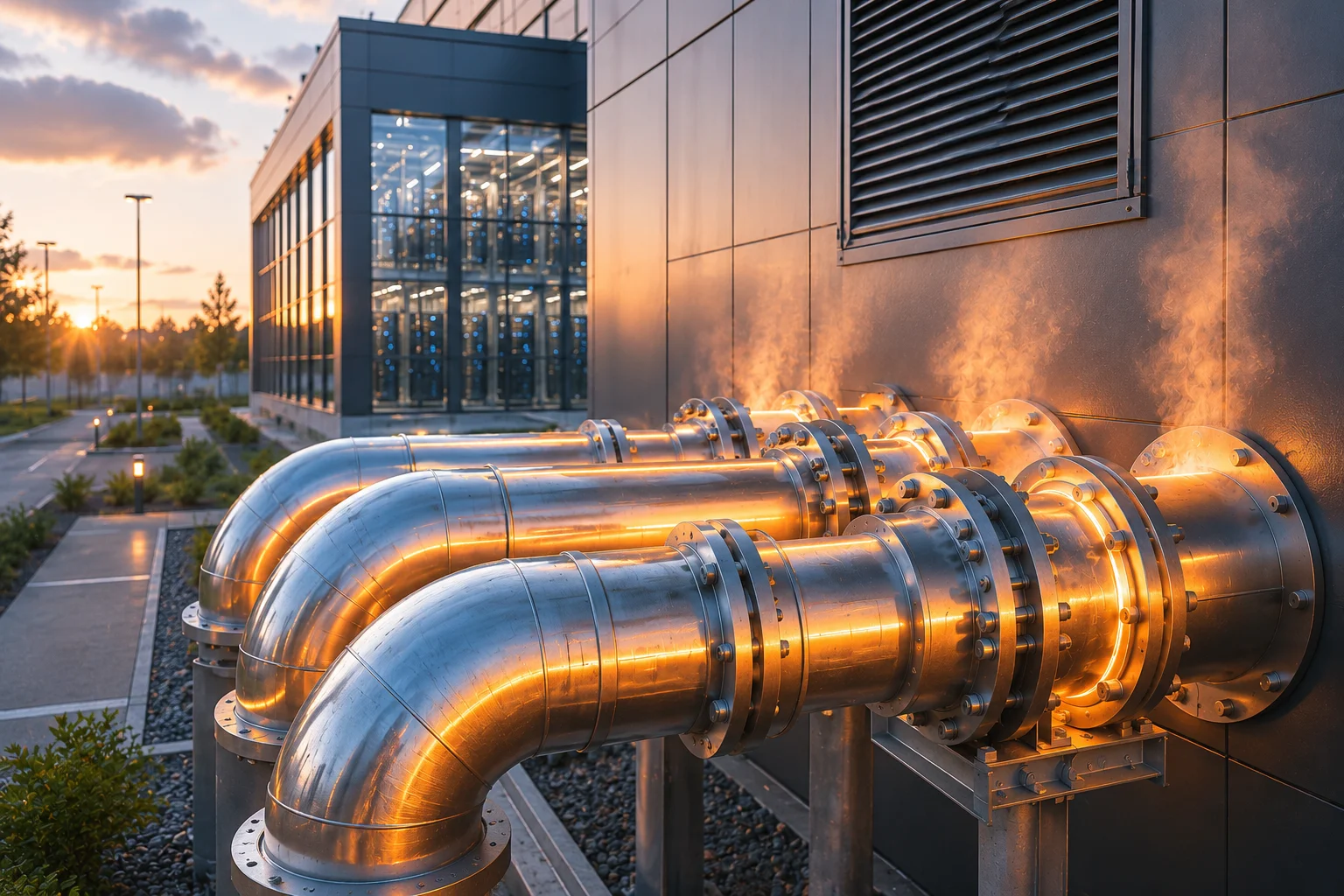
What changes, in figures.
Reference: 10 MW IT data center, 150 kW per rack.
| Heat available to the network | 40,800 MWh/year |
|---|---|
| Nature of the heat | Decarbonised (zero direct emissions) |
| Estimated revenue (€65/MWh) | ~€2.65M/year |
| Electricity savings (PUE 1.12 → 1.01) | ~€1M/year |
| Cooling-battery CAPEX avoided | ~€900K |
| DC bus 800V | Native compatibility |
| Water consumption | <2 m³/year |
| CO₂ avoided | 18,200 tCO₂/year |
| Payback | 3.1 years |
| Customer IRR | ~30% |
€65/MWh used as a reference tariff. The final value depends on the contract with the DHC operator.
When this solution is not the right choice.
DHC mode does not make sense in these cases. We tell you upfront, before you book the call.
- You are more than 2 km from an active DHC network
- The DHC operator has no capacity for continuous heat off-take
- Your site has physical constraints that prevent a thermal connection
- The 800V DC bus advantage only pays off in full if your power infrastructure is, or will be, compatible
In those cases: consider RHP + Thermal Storage for thermal autonomy, or Energy as a Service for zero CAPEX.
Validated technology. Ready to scale.
Pilot plant operational since June 2026 on the base technology (small-scale Carnot battery). Measured performance exceeds expectations on COP and heat recovery.
Reversible ORC patent filed October 2025. Co-inventors: Marco Margotti (CEO, 20 years B2B + 6 years on ORC Kaymacor) and Giuseppe Toniato (CTO, 30 years of thermodynamic systems).
The technology is validated. We are ready to bring it to commercial plants up to 10 MW IT and beyond.
Let's check whether your site qualifies.
30 minutes of technical analysis: distance from the nearest DHC network, available thermal power, preliminary business case.
See also: RHP + Thermal Storage· Energy as a Service